Dear Brethrens,

2013, the
Water-Snake year, marks a century since I made the proclamation of Tibet’s
independence on the eighth day of the first month of the Water-Ox year. In the
declaration I wrote, ‘Now the Chinese intention of colonizing Tibet under the
patron-priest relationship has faded like a rainbow in the sky…’ and ‘[t]he
Tibetan government’s civil and military officials, when collecting taxes or
dealing with their subject citizens, should carry out their duties with fair
and honest judgment so as to benefit the government without hurting the
interests of the subject citizens.’ Twenty years later, in my last testament, I
stated that ‘the future holds darkness and misery,’ and, to quote the Great
Fifth Dalai Lama, ‘the time of the flute has changed to the whistle of an
arrow.’
Now my country
is under foreign occupation. This colonial subjugation has been going on for
more than half a century and Communist China’s systematic propaganda and
re-writing of our history has produced a generation of Tibetans who have no
concept of their past glories and cultural heritage. It is hence imperative for
you today to reclaim, reassert and reaffirm our history because the power of our
past determines our future; the reality of our past gives us the strength,
fortitude and vision to achieve a free Tibet where we can rule ourselves in
tune with our culture and values. This reclamation of history is a battle of
truth against falsehood, memory against censorship, and legitimacy against
occupation.
In 1933 I stated
that we must ‘[m]aintain friendly relations with the two great powers, China
and India, conscript able soldiers to guard the borders and make them
sufficiently strong to ward off those countries with whom we have had border
disputes. The armed forces should be drilled and disciplined so as to be
effective and strong to overcome those who threaten us.’ Much water has flowed
under time’s bridge since I said these words. The world that I knew has long
since disappeared. Old boundaries have been erased and new ones drawn.
Consequently, we need to not only obsessively invest in education and
accumulate knowledge but also develop tactical wisdom to translate our vast
global goodwill into concrete political support. China is no longer the weak
and strife-torn country of a century ago: it has metamorphosed into an
economically strong nation that thuggishly flexes its muscles at anyone and any
country that dares to speak or openly support us Tibetans. This harsh reality
calls for fresh ideas, better strategies and long-term vision. We must build
new forces such as concerted multi-lateral actions and strategic non-violent
campaigns. We must cease to beg with folded hands at the earless walls of the
United Nations and start to take our struggle to the next level with
self-assuredness and inner strength. The People’s Republic of China may have
the largest cash reserve in the world but it is a giant balloon with millions
of needles piercing from within. Its leaders are blinkered, its system corrupt
and its future uncertain.
Nevertheless,
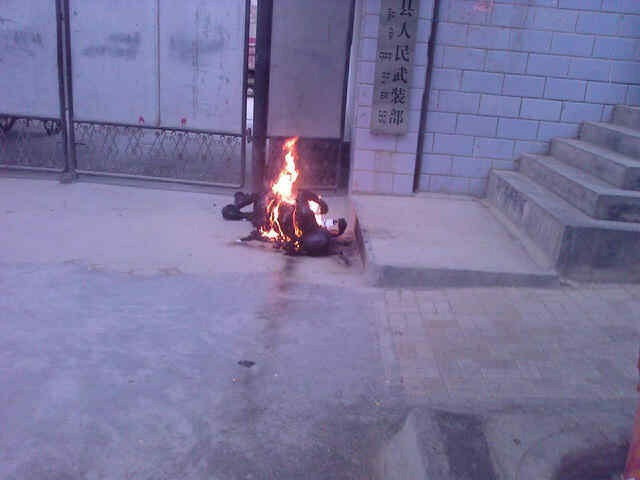
the Communist Party’s stranglehold over Tibet continues. Our beloved country is
passing through a long and dark night and my people are immersed in immense
suffering. The socialist hell imposed by Mao Zedong and his successors has
brought a life-and-death struggle to Tibet and its people, driving many of them
to set themselves on fire as a last, non-violent, resort to express their
dissent. There is no pain deeper and no sacrifice greater than a
seventeen-year-old nun dousing herself in petrol and turning into a fiery ball
of protest while calling for Tibet’s independence. Without bitterness,
animosity and hatred towards her oppressors, this teenage nun’s motivation is
the highest level of bodhicitta.
Looking at the sheer selflessness, loyalty and courage of such young people,
there is great hope for the future.
But the task at
hand is not easy and the road ahead will be long. The sacrifice and dedication
of our brothers and sisters in the Land of Snow have set a new standard in our
struggle. Now it is the responsibility of those living in relative freedom in
exile to match and surpass this level of commitment and devotion to our fight
for independence. I know that with your linguistic skills and creativity,
access to the global leaders, information and the news media, you are uniquely
positioned to fulfil this historic duty.
However, over
the past few years I have noticed that some of you, who are highly educated and
articulate, have been using your precious time and intelligence to point
fingers at each other. Moreover, sadly, some of our rangzen warriors, who may not even have seen the corridors of our government-in-exile,
are loudly shouting against it. Democracy can be frenzied and complicated,
especially our tsen-jol bod-shung, which
functions under the auspices and goodwill of its host country. Our government
may not be operating as efficiently as you would wish and you may not agree
with some of its policies. But just as you have one biological mother and
father, you have only one legitimate government that represents our people
living on both sides of the Himalayas. No other institution can replace this.
If you took the trouble to find out, there are democratic channels through
which you can air and register your disagreements – rationally, maturely and
transparently. There is no need to hide behind a veil of social networks to
motormouth your personal frustrations. A couple of rangzen advocates may have strong extremist leanings. Fanaticism,
we all know, is the last refuge of cowards. Others, while criticising bod-shung, have gone to the extreme of
comparing our democratic government with despotic one-party-ruled China. Please
be extremely careful with your click-happy fingers and acidic comments. Rot comes
in small doses and sometimes without clear intent.
Our struggle for
freedom is not a long-distance shouting match. It is nothing less than a
revolution against tyranny. Revolution is a strategic vision backed up by a
systematic campaign. Revolution is the might of a pen matched by the strength
of action. Revolution is a mission leading to independence. It is the
willingness to sacrifice everything and to march forward with hope grounded in
reality. Revolution rejects submission to suppression. Our revolution is an act
of resistance which fundamentally challenges China’s occupation of our homeland
and, in the process, kindles our collective consciousness to coalesce ourselves
into a single fabric called ‘Tibet’.
This revolution
is not about who can point a finger at whom the fastest. Nor it is a contest to
see who can use more invectives against our people by calling them ‘spineless’,
‘incompetent’ and branding our exile government as ‘self-serving’. If rangzen is to have any resonance with our
people and if our struggle is to succeed, hurling tirades is not the right
approach. You should not bombard others with your own inadequacies and
failures. ‘It is those who know how to rebel, at the appropriate moment,
against history who really advance its interests,’ wrote Albert Camus. And yet
some of our fervent rangzenpas don’t
even seem to know who to rebel against.
Knowledge
without understanding of wider historical and geopolitical perspectives has
very little value. Information without practical application has no meaning.
Passion without a purpose is pointless. This is why sometimes I feel that some
of you have mouths that cover the entirety of your heads, and your heads are
bigger than your bodies. A few of you have this habit to hang around only with
your tiny circle of ‘like-minded’ people. The battle to make rangzen a national policy must involve
all of our people, more so those who have differing political orientations.
More importantly, it involves lobbying our parliamentarians to reflect people’s
aspirations. Independence for the Snowland cannot be achieved only with tiny
exclusive meets in far-away places over coffees and wafers. Revolution must
begin with awakening the masses.
‘Involve me and
I will understand’ goes an ancient proverb. More than any time in our long
history, and more than any other moment in our recent past, there is an urgent
need now to bring all tsampa-eaters
together to push for a singular collective goal of a free Tibet. This requires charisma,
leadership and vision. Where is our new Songtsen Gampo? Where is our new
Milarepa? Where is Gesar? Where is Yonripon? My brethrens, search the deepest
recesses of your minds, explore the tiniest corners of your hearts and hunt the
most tortuous labyrinths of your memories, because the seed that can grow into
a tree of leadership is within each of you. Keep in mind that you live to
witness the ray of freedom rise and not to observe the shadow of repression
swell.
Remember, I
experienced exile too, and I know how desolate it feels to return to your cold
rented houses each night. I also know how our people live in our homeland under
occupation each day like sheep tethered in a slaughterhouse. In a letter dated
26 August 2012, one of our brothers in the Land of Snow wrote, ‘Tibetans in
exile must have the courage to aim all your strength at a single goal. This is
our expectation. The life of our nation and its freedom are directly and deeply
intertwined with, and depending, on you all.’ The way forward is thus to unite
and rise up.